Solar Return Timing: Profections, Eclipses, and the Key Windows of Your Year
June 28, 2026 · 9 min read · The TriMoon Team
 AI-generated. Written by a model and not reviewed by a person.
Turn your astrological birthday into a personalized forecast for the year ahead — $25, one-time.
Get your Solar Return — $25 →
A solar return doesn't all happen at once. Annual profections, eclipse seasons, and slow transits mark the windows when the year's themes come forward. Here's how the timing of a solar return year works.
Why a Solar Return Year Unfolds in Waves
A solar return chart gives you a map of the themes likely to be emphasized between one birthday and the next. But a year is a long stretch of time, and those themes do not all arrive at once on the morning of your return. The year unfolds in waves — certain stretches light up energies already present in the chart, while others stay comparatively quiet. Understanding solar return timing means learning to read when the year's themes are most likely to come forward, rather than treating the whole twelve months as a single undifferentiated block.
Think of the solar return chart as the script for a play and the year as the performance. The script tells you which themes are in the story; the timing tells you roughly when each scene is most likely to take the stage. A house that the chart highlights might feel dormant for months and then become a clear point of focus during a particular window. This is why two people with similar-looking solar returns can have very differently paced years — the same material can surface in a different order and rhythm for each of them.
Astrologers use a handful of well-established techniques to read this rhythm. The three covered here are annual profections (which assign a guiding theme to the whole year), monthly profections (which subdivide the year into roughly twelve shorter chapters), and the movement of real astronomical events — eclipses and the slow-moving outer planets — across the sensitive points of your chart. Each one is a different lens on the same question: when, across the year, is a given theme most likely to be activated?
Before going further, one frame matters more than any technique, and it runs through this entire article: timing in astrology marks periods of emphasis, not predictions. A window does not tell you what will happen or guarantee that anything will. It points to a stretch when a particular area of life is more likely to ask for your attention — an invitation to engage, not a fixed outcome. You always retain agency in how you meet it. Hold that idea as you read on; everything below is meant in that spirit.
Annual Profections & the Year-Lord
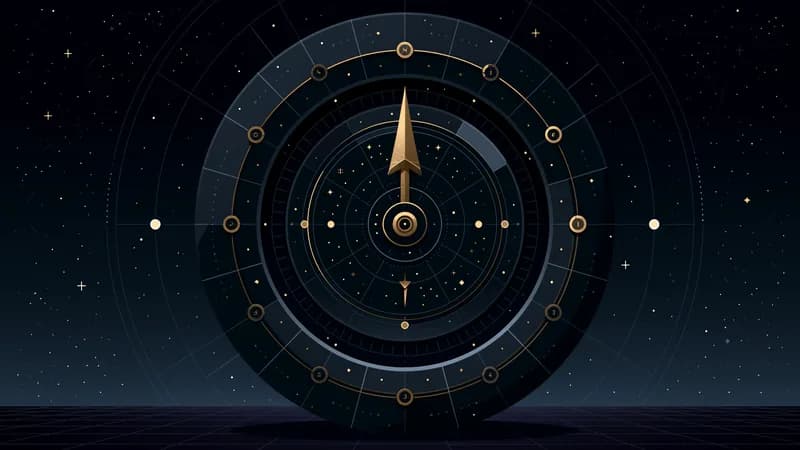
Of all the timing techniques in traditional astrology, annual profections are the simplest to learn and one of the most illuminating — so let's take the time to explain them plainly and accurately. Profections are a way of advancing your chart forward by one whole sign for each year you are alive, which highlights a different house — and a different planet — as the keynote of each year of life.
Here is the whole mechanism. Profections are whole-sign: your first house is the sign on your Ascendant, your second house is the next sign, and so on around the wheel. In your very first year of life (age 0) the emphasis sits on the first house. At age one it advances one whole sign to the second house, at age two to the third, and so the pointer walks forward one house per birthday. Because there are twelve houses, the cycle repeats every twelve years. The arithmetic is friendly: take your age, divide by twelve, and the remainder gives you the profected house counted from the first. So ages 0, 12, 24, 36, 48 all return the emphasis to the first house; ages 1, 13, 25, 37 land on the second; ages 11, 23, 35 land on the twelfth — and the pattern continues for life.
The house the year lands on tells you which arena of life is foregrounded — a year profected to the house of partnership tends to put relationships in the spotlight, while one profected to the house of career tends to emphasize work and public direction. But profections add a second, richer layer. The planet that rules the sign of the profected house becomes the year-lord: the planet whose themes color the entire year. (Profections use the traditional rulerships — Mars rules Aries and Scorpio, Venus rules Taurus and Libra, Mercury rules Gemini and Virgo, the Moon rules Cancer, the Sun rules Leo, Jupiter rules Sagittarius and Pisces, Saturn rules Capricorn and Aquarius.) If your profected house falls in Libra, for instance, Venus becomes your year-lord, and Venusian themes — relationship, value, harmony, what you find worth cultivating — tend to run as a thread through the months ahead.
The year-lord is the bridge between your birth chart and your solar return: wherever that planet sits in your natal chart, and wherever it lands in the current solar return, becomes especially worth noticing this year. This is exactly the kind of personalized cross-referencing a full reading does for you — but the concept itself is simple. The meaning of a profection year is not a forecast of events; it is a statement of which themes are emphasized and which planet carries them. What you do with that emphasis remains entirely yours.
Monthly Profections: the Year in ~12 Chapters
Annual profections give the year a single overarching keynote. Monthly profections zoom in one level and divide that year into roughly twelve shorter chapters, each with its own emphasis — turning a twelve-month span into a readable sequence rather than one long stretch.
The logic mirrors the annual technique exactly, just at a faster pace. Where the annual pointer advances one whole house per year, the monthly pointer advances one whole house per month — beginning, each year, from your profected annual house. So the opening chapter of the year shares the emphasis of the annual house, and then the focus walks forward one house roughly every month, touring all twelve houses over the course of the year before the next birthday resets the cycle. Each of those monthly periods quietly spotlights a different area of life and activates its own ruling planet, so the year reads as a progression of emphases rather than a flat plateau.
This is part of why a year rarely feels uniform from the inside. One stretch may quietly foreground home and roots; a later stretch may shift the emphasis toward communication, or money, or partnership. None of this dictates what happens — a month emphasizing partnership does not promise a relationship event any more than it forbids one. It simply suggests where attention may naturally gravitate during that chapter. The chapters are signposts for reflection, not a calendar of guaranteed events.
Monthly profections also pair naturally with the annual year-lord. When a monthly chapter brings the focus around to the house your year-lord rules, or the house it occupies, that chapter can feel like a smaller echo of the year's larger theme — a window where the year's main thread is briefly underlined. Used this way, the monthly layer doesn't replace the annual one; it adds texture and sequence to it, helping you read the year as a story that moves through phases rather than a single mood that hangs over everything at once.
Eclipses Inside Your Year
Beyond profections, real astronomical events also help shape the rhythm of a solar return year — and among the most striking are eclipses. Eclipses arrive in seasons, clustered around two windows each year when the Sun, Moon, and the lunar nodes line up closely enough to produce solar and lunar eclipses within a couple of weeks of each other. Any eclipse seasons that fall inside your solar return year can mark windows that tend to carry extra weight. If you'd like the underlying mechanics first, our companion piece on how solar and lunar eclipses work explains the astronomy in plain terms.
In astrological tradition, eclipses are associated with turning-point windows — stretches where a theme seems to gather momentum, come to a head, or shift direction. The reason astrologers pay attention to where an eclipse falls is that an eclipse landing near a sensitive point in your chart — close to an angle, the Sun, the Moon, or another personal placement — tends to draw that area of life into the foreground for a time. The closer the alignment to a meaningful point, the more an astrologer might flag that season as one worth being awake to.
It is worth being especially careful with eclipses, because they attract more dramatic, fatalistic language than almost anything else in popular astrology — and that language is exactly what this article asks you to set aside. An eclipse near a chart point is a period of emphasis, not a verdict. It does not deliver a predetermined event, reward, or catastrophe. A more grounded reading treats an eclipse window as a time when a particular theme may come forward more insistently, inviting honesty and attention — and leaves entirely open how you choose to respond. The sky sets a stage; it does not write your lines.
For the same reason, this article gives you the concept of eclipse windows rather than specific dates or a precise method for pinpointing them. Eclipse timing is real and calculable, but turning it into something useful for your chart means seeing how each season relates to your own placements — work that belongs in a personalized reading. The general principle is enough: eclipse seasons inside your year are stretches to notice, held lightly, as invitations rather than instructions.
Slow Transits to Your SR Chart
The third layer of timing comes from the slow-moving planets — Jupiter, Saturn, Uranus, Neptune, and Pluto — as they continue their journey through the sky after your solar return is cast. When one of these slow movers forms an aspect to a point in your solar return chart, it dates a window during the year when that point's themes are more likely to be activated. Because these planets move gradually, the windows they create tend to be broad and slow to build rather than sudden — which makes them some of the most recognizable rhythms of a year. To understand the geometry of how a moving planet "contacts" a chart point, our overview of planetary transits is a useful primer.
The pace of each planet shapes the character of its window. Jupiter, which takes about twelve years to circle the zodiac, brings comparatively shorter contacts associated with expansion, opportunity, and growth in whatever it touches. Saturn, on its roughly twenty-nine-year cycle, brings longer, more demanding windows associated with structure, responsibility, and consolidation. The outermost three — Uranus, Neptune, and Pluto — move slowly enough that a single contact can color a wide stretch of the year, lending it an undertone of awakening (Uranus), dissolving or sensitizing (Neptune), or deep, gradual transformation (Pluto). Knowing which slow planet is contacting your chart, and roughly when, gives the year a sense of texture and sequence.
What makes these contacts matter for a solar return specifically is where they land. A slow transit touching one of the angles of your solar return chart, or its Sun, Moon, or ruler, tends to draw extra emphasis to whatever that point represents for the year. This is one of the ways the solar return and the wider moving sky talk to each other: the return sets the stage for the year, and the slow transits highlight when its key points are most likely to come alive.
As with everything in this article, these windows are periods of emphasis, not predictions. A Saturn contact does not promise hardship, and a Jupiter contact does not guarantee a windfall; each simply marks a stretch when a particular theme is more available to be worked with — and how it actually unfolds depends a great deal on how you meet it. The slow transits tell you when the volume is turned up on a theme. They do not tell you what you will do with the sound.
Reading Timing as Emphasis, Not Prediction
If there is one idea to carry away from this entire article, it is the one that has run through every section: astrological timing describes periods of emphasis, not fixed outcomes. Profections, eclipse seasons, and slow transits all answer the same modest question — when across the year is a given theme most likely to come forward? None of them answers what will happen, because that part is not written in advance. The windows are invitations to pay attention, not scripts to be performed.
This distinction is not just a disclaimer; it is the most accurate and the most useful way to work with timing. A predictive frame puts you in the passive role of waiting to see what the year does to you. An emphasis frame puts you in the active role: here is a stretch where partnership, or work, or home, or your inner life is likely to be highlighted — so how do you want to meet it? Read this way, timing becomes a planning tool. You can lean into a growth-flavored window, move gently and deliberately through a more demanding one, and bring extra awareness to the turning-point seasons. The agency stays with you throughout.
It also helps to hold all three layers together rather than fixating on any single one. The annual profection sets the year's keynote and its year-lord; the monthly profections give it a sequence of chapters; eclipses and slow transits date the windows where those themes are most likely to intensify. No single technique is the whole picture, and none of them overrides your own choices, circumstances, and effort. They are a way of listening to the year's rhythm — and listening is not the same as obeying.
If you'd like to see how these windows fall for your own year specifically, a TriMoon Solar Return Chart Interpretation maps the year's timing windows — profections, eclipses, and major transits — as periods of emphasis to work with, not a script. It's the personalized counterpart to the ideas here, mapped to your actual chart, so you can see which themes are foregrounded and roughly when, and decide for yourself how to respond.
This article was written by AI and has not been reviewed by a person. The astronomy behind it is TriMoon's own precise ephemeris data — not generic horoscopes.