Your Big Three: How Your Sun, Moon, and Rising Signs Work Together
June 10, 2026 · 9 min read · The TriMoon Team
 AI-generated. Written by a model and not reviewed by a person.
Turn your birth chart into a personalized, book-length reading — $25, one-time, ready in minutes.
Get your Natal Chart — $25 →Want to see your own chart first? Calculate it free.
Free natal chart calculator →
Your Sun, Moon, and Rising signs are astrology's 'Big Three' — the core trio that shapes identity, emotion, and first impressions. Here's what each one governs and how they work together.
What the 'Big Three' Means
In astrology, the term Big Three refers to a specific trio of placements in your birth chart: your Sun sign, your Moon sign, and your Rising sign (also called the Ascendant). Together, these three points form the backbone of any first reading. While a complete chart contains a dozen planetary placements scattered across twelve signs and twelve houses, the Big Three is where most astrologers begin — and where most people first see themselves reflected. To find your own Big Three, the free natal chart calculator shows all three from your birth date, time and place.
The reason these three carry the most weight is partly structural and partly practical. The Sun and Moon are the two brightest objects in the sky and the fastest, most personal markers of who you are; the Rising sign anchors the entire chart in time and space, setting the framework that everything else is measured against. Without these three, a reading has no center of gravity.
Think of the Big Three as three different lenses on the same person. The Sun shows what you are reaching toward — your core identity and sense of purpose. The Moon shows what you need to feel safe and whole. The Rising shows how you arrive in a room before you have said a word. None of the three tells the whole story alone, but read together they sketch a remarkably full portrait.
This is why two people who share a Sun sign can feel so different from one another. A pair of people born under the same Sun may have wildly different Moons and Risings, and those differences account for much of what makes each of them distinct. Understanding all three is the difference between a flat, one-note description and a three-dimensional one.
Your Sun Sign: Core Identity
Your Sun sign is determined by the Sun's position along the zodiac at the moment of your birth, and it is almost certainly the placement you already know. When someone says "I'm a Libra" or "I'm a Scorpio," they are naming their Sun sign — the part of astrology that has filtered into everyday conversation and the back pages of magazines.
The Sun represents your core identity: your vitality, your sense of purpose, and the conscious self you are growing into over a lifetime. In traditional symbolism the Sun is associated with the ego in its healthiest sense — not arrogance, but the organizing center of a personality, the thing that gives your choices direction. It describes the qualities you most want to express and the kind of person you are working to become.
Because the Sun moves through roughly one sign per month, your Sun sign is shared by a large slice of the population, and on its own it paints in broad strokes. It speaks to temperament and motivation more than to the specific texture of your inner life. A Sun in a fire sign tends toward boldness and momentum; a Sun in an earth sign leans practical and steady; air favors ideas and connection; water favors depth and feeling.
It helps to think of the Sun as the role you are meant to grow into rather than a fixed description of who you already are. People often feel they "become" their Sun sign more fully as they mature, settling into its purpose over the years. That sense of stepping into yourself is exactly what the Sun is meant to capture.
This is also why the Sun alone can feel either spot-on or strangely off the mark depending on the person. Someone whose other placements support their Sun will often recognize themselves immediately in its description. Someone whose Moon or Rising pulls in a different direction may read the same description and think it captures only a part of them — usually the part they grow into most visibly with age, rather than the way they feel from the inside.
Your Moon Sign: Inner Emotional World
If the Sun is who you are becoming, the Moon sign is how you feel along the way. The Moon governs your inner emotional world: your instincts, your needs, your habits of self-soothing, and the private self that surfaces when you are at home and unguarded. It is the part of you that reacts before you have had time to think.
Where the Sun is public and purposeful, the Moon is intimate. It describes what makes you feel secure, how you process feelings, and the conditions you need in order to rest and recover. Some Moon signs need solitude and quiet to recharge; others need company, conversation, or the comfort of a familiar routine. Your Moon sign often shapes what "feeling cared for" actually means to you — and why the same gesture can land so differently for two different people.
The Moon also carries a quality of memory and conditioning. It reflects the emotional patterns you absorbed early in life, the reflexes that run beneath conscious choice. This is why people sometimes describe their Moon sign as the version of themselves they show only to those closest to them, or the self they meet in moments of stress and vulnerability.
Because the Moon moves quickly — changing signs every two to three days — your Moon sign is more individual than your Sun sign, and pinning it down precisely usually requires knowing your birth time. Two people born on the same day can easily have the Moon in different signs, which is one reason emotional temperament varies so much even among people who share a birthday.
Knowing your Moon sign tends to be quietly clarifying. It can explain why you recharge the way you do, why certain environments leave you drained while others restore you, and why your needs do not always match the confident image your Sun sign projects. Many people find their Moon sign describes the part of them that close friends and family would recognize most readily.
Your Rising Sign: The First Impression
Your Rising sign, or Ascendant, is the zodiac sign that was climbing over the eastern horizon at the exact moment and place of your birth. It is the most time-sensitive of the Big Three: the Rising sign changes roughly every two hours, so even a small error in your recorded birth time can shift it to the neighboring sign entirely.
The Rising sign governs first impressions — the version of you that people meet before they know you well. If the Sun is your core and the Moon is your private inner life, the Rising is the doorway between the two and the outside world. It shapes your outward manner, your instinctive style of approaching new situations, and the surface others read on a first encounter. It is sometimes called a mask, though a more generous way to put it is that the Rising is the lens through which your whole personality is filtered on its way out.
The Ascendant does more than describe surface impressions, though. In chart construction it sets the foundation for the entire wheel: it determines where each house begins and therefore where every planet lands. This is why the Rising is so structurally important — change the Rising, and you rearrange the whole map of someone's life. Two people with identical Sun and Moon signs but different Risings can lead chart structures that point in completely different directions.
Because it touches both appearance and the architecture of the chart, the Rising rewards a closer look than most people give it. To understand how the Ascendant is calculated, why birth time matters so much for it, and what each Rising sign tends to convey, see our deeper guide to your rising sign and the Ascendant.
When the Three Agree — and When They Clash
The most interesting part of the Big Three is not any single placement but the relationship among them. Sometimes the Sun, Moon, and Rising reinforce one another; sometimes they pull in different directions. Both arrangements are common, and both produce recognizable real-life patterns.
When the three are in harmony — sharing an element, for instance, or signs that traditionally get along — a person tends to feel internally consistent. The way they present matches the way they feel matches what they are reaching for. There is little friction between the public self, the private self, and the first impression, and others often describe such people as easy to read or "what you see is what you get." The risk of this arrangement is a kind of one-note quality: the same strengths and blind spots show up everywhere, with little internal counterweight.
When the three clash, the experience is more layered and, often, more interesting. Imagine a bold, fiery Sun paired with a guarded, watery Moon and a cool, reserved Rising. To the outside world this person may read as calm and contained, while inside they run hot with ambition and feel emotions far more intensely than they let on. The mismatch can feel like being misunderstood — people respond to the surface and miss the engine underneath — but it also gives a person genuine range and depth.
None of these combinations is better or worse than another; they simply describe different internal weather. A clashing Big Three is not a flaw to be fixed but a set of distinct voices that a person learns to coordinate over time. Much of self-understanding through astrology comes from recognizing which voice is speaking in a given moment — the Sun's drive, the Moon's need, or the Rising's instinct to meet the world a certain way.
Reading the Trio as a Whole
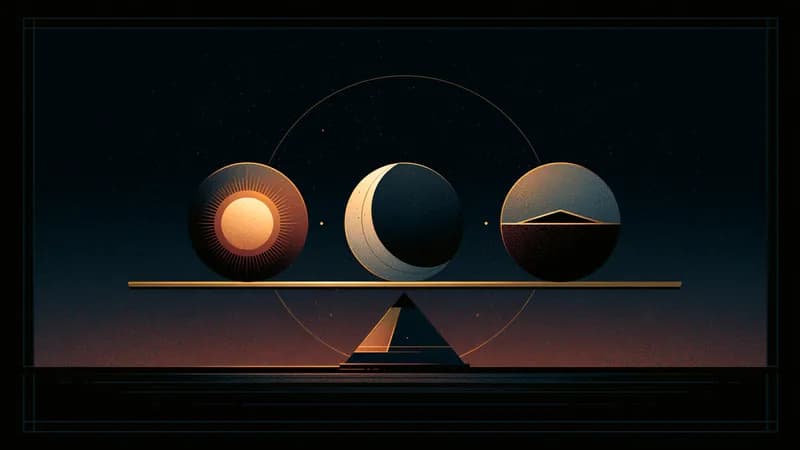
The single most important habit in working with the Big Three is to read them together rather than in isolation. It is tempting to look up each placement separately and stack three tidy descriptions on top of one another, but that approach misses the point. The meaning lives in the synthesis — in how a particular Sun, Moon, and Rising modify and color one another into a single, coherent person.
Synthesis is also what separates a real reading from a generic one. A fiery Sun reads very differently behind a reserved Rising than it does behind a matching fiery Rising; a sensitive Moon expresses itself one way under a practical Sun and quite another under a restless, airy one. The trio is a conversation, not a list, and learning to hear that conversation is the heart of chart interpretation.
Two of the three placements depend heavily on an accurate chart. The Moon can change signs within a single day, and the Rising shifts every couple of hours, so both require your exact birth date, time, and place to be calculated correctly. If you are new to the mechanics of how all of this is plotted, our overview of what a natal chart is walks through how the wheel is built. And once you have your Big Three placed, the next layer of meaning comes from the houses they fall in — the life areas each one operates within — which our guide to the twelve houses explains in detail.
Reading the trio as a whole is exactly the kind of synthesis that benefits from a careful, personalized interpretation. A TriMoon Natal Chart Interpretation reads your Sun, Moon, and Rising together — generated from your exact birth date, time, and place — so the three are woven into one portrait rather than three disconnected summaries. However you approach it, the goal stays the same: to see the Big Three not as separate labels but as three facets of one whole person.
This article was written by AI and has not been reviewed by a person. The astronomy behind it is TriMoon's own precise ephemeris data — not generic horoscopes.