What Is a Natal Chart? A Complete Beginner's Guide to Your Birth Chart
June 9, 2026 · 10 min read · The TriMoon Team
 AI-generated. Written by a model and not reviewed by a person.
Turn your birth chart into a personalized, book-length reading — $25, one-time, ready in minutes.
Get your Natal Chart — $25 →Want to see your own chart first? Calculate it free.
Free natal chart calculator →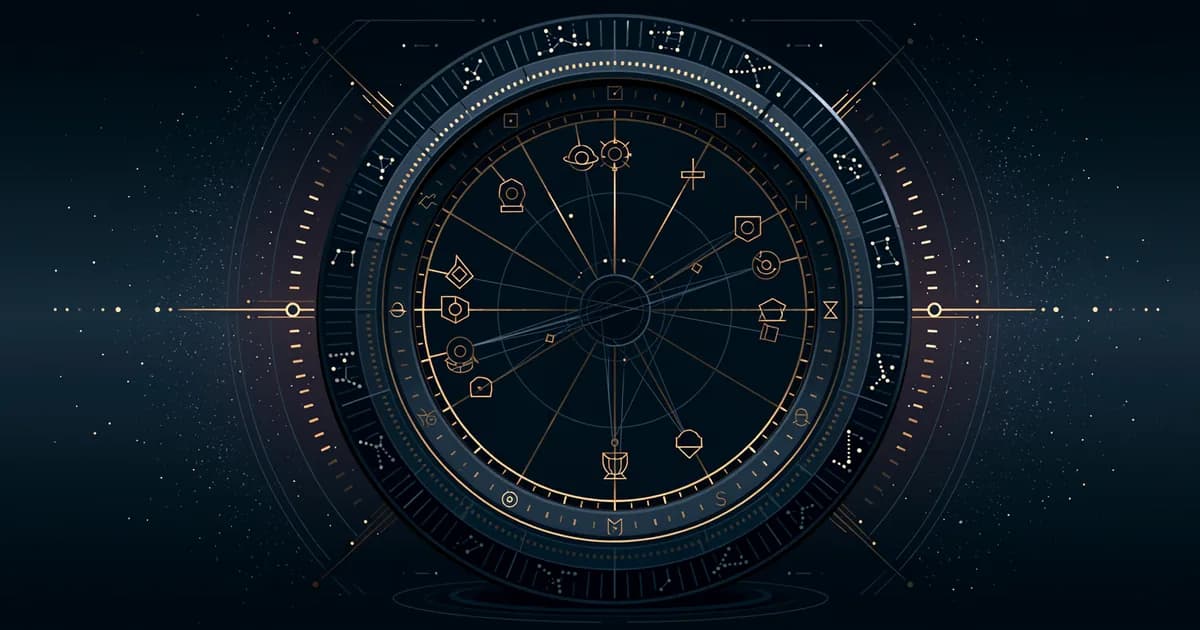
A natal chart is a snapshot of the sky at the exact moment you were born — and the foundation of all personal astrology. This beginner's guide explains what a birth chart is, the building blocks it's made of, and how to start reading yours.
What a Natal Chart Actually Is
A natal chart is a precise diagram of where every planet, the Sun, and the Moon sat in the sky at the exact moment and place you were born. Astronomers can calculate those positions to the arc-minute, and astrology arranges them into a circular map. The word natal simply means "relating to birth," which is why the same diagram is also called a birth chart. The two terms are interchangeable, and you will see both used throughout astrology. Want to see yours? The free natal chart calculator draws your chart from your birth date, time and place.
The most important thing to understand about a natal chart is that it is frozen in time. The sky is in constant motion — planets cross the zodiac at their own speeds, the Moon shifts signs every couple of days, and the entire pattern overhead rotates once roughly every twenty-four hours. But your chart captures one single instant of all that movement and holds it still. Those positions never change. You are born once, the shutter clicks, and the resulting image belongs to you for life. Astrologers still have ways of following change over a lifetime: in secondary progressions, for example, each day after birth counts as one year of life.
A useful way to picture it is as a map of the sky drawn from your exact vantage point on Earth. Just as a geographic map flattens a round planet onto a page, a natal chart flattens the dome of the heavens into a flat wheel. The circle represents the band of sky the planets travel through; the markings around its edge show the twelve zodiac signs; and the symbols placed inside show where each celestial body was at your birth. Read that way, the chart is less a mystical object than a coordinate system — a structured record of one moment in the sky.
Because it is permanent, the natal chart is the foundation that everything else in personal astrology builds on. Forecasts, compatibility readings, and timing techniques all reference back to this fixed starting point. Before any of those can mean anything, you need to understand the chart itself.
The Three Building Blocks: Planets, Signs, and Houses
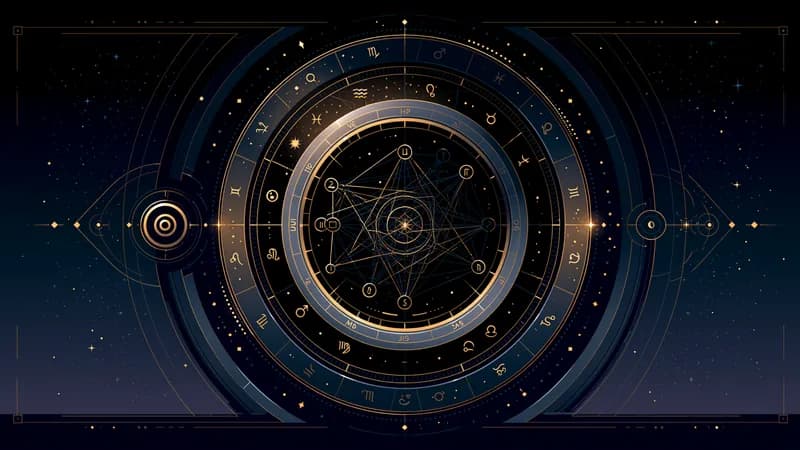
Nearly everything in a natal chart comes down to three kinds of information working together: planets, signs, and houses. Once you understand what each one contributes, the wheel stops looking like a cluttered diagram and starts reading like a sentence with a subject, an adjective, and a setting.
The planets are the what. In astrology, the term "planets" is used loosely to include the Sun and Moon alongside Mercury, Venus, Mars, Jupiter, Saturn, Uranus, Neptune, and Pluto. Each one represents a basic drive or function within you. The Sun is your core identity and vitality; the Moon is your emotional nature; Mercury governs thinking and communication; Venus relates to love and values; Mars is drive and assertion. The slower outer planets carry broader, more generational themes. Think of the planets as the cast of characters — the active forces that do something.
The signs are the how. Each of the twelve zodiac signs — Aries through Pisces — colors the planet that occupies it with a distinct style and quality. A planet expresses its function through the personality of its sign. Mars in bold, headfirst Aries pursues goals very differently from Mars in patient, deliberate Taurus, even though both are still "Mars," still the drive to act. The sign doesn't change what a planet does; it changes the manner, tone, and flavor of how it does it.
The houses are the where. The chart is divided into twelve segments called houses, and each governs a specific arena of life: identity and appearance, money and resources, communication, home and family, creativity, work and health, partnership, and so on around the wheel. A planet's house placement shows the area of life where its energy most naturally plays out. Mars in the house of career channels drive into ambition and professional effort; the same Mars in the house of partnership directs that energy toward relationships instead.
Put the three together and you get a complete statement. What (a planet) expresses itself how (through its sign) and where (in a particular house). "Venus, in expressive Leo, in the house of partnership" reads as a recognizable phrase once you know the grammar. Learning to combine these three layers is the heart of chart interpretation.

Angles and Aspects: How the Pieces Connect
Planets, signs, and houses give you the vocabulary, but two more features turn that vocabulary into a connected picture: the angles and the aspects.
The angles are four special points where the chart wheel meets the horizon and the meridian. The two most important are the Ascendant and the Midheaven. The Ascendant — also called the Rising sign — is the zodiac degree that was climbing over the eastern horizon at the moment of birth. It marks the start of the first house and sets the orientation for the entire wheel, which is why it shapes how you instinctively approach the world and come across to others. The Midheaven, the highest point of the chart, relates to your public role, reputation, and direction in life. Because the angles depend on the exact rotation of the sky at your birth, they are among the most personal points in the whole chart.
Aspects describe the geometric relationships between the planets — the angular distances they form to one another around the circle. When two planets sit a particular number of degrees apart, astrologers say they are "in aspect," and that connection links their meanings. A conjunction fuses two planets together; an opposition places them across the wheel in tension; a square creates friction that pushes for action; a trine lets energy flow easily between them. Reading aspects is how you move from interpreting planets one at a time to understanding how the forces in a chart cooperate or compete.
When several aspects cluster together, they can form larger geometric figures with names and characters of their own. These recurring shapes — the recognizable figures that aspects form — give a chart distinctive structure and are worth learning once you are comfortable with individual aspects. Aspects also matter far beyond the birth chart: the same angular relationships, measured as planets keep moving after your birth, are the basis of how aspects work in motion and drive astrological forecasting. The geometry you learn in the natal chart is the same geometry you will use everywhere else.
Why the Whole Chart Beats Your Sun Sign
Most people who know any astrology know their Sun sign — the sign the Sun was in when they were born, the one you get from your birthday alone. It is the answer to "what's your sign?" and the basis of newspaper horoscope columns. The Sun sign is genuinely meaningful: it describes your core identity and the central thread of your character. But it is only one placement out of dozens in a full chart, and treating it as the whole story is like describing an entire film by naming a single actor.
Consider that everyone born on the same calendar day shares a Sun sign, yet they are obviously not all alike. The difference is everything else in the chart. Your Moon might be in one sign and your Mercury in another; your Venus, Mars, and every other planet each sit in their own sign and house. Two people with identical Sun signs can have almost nothing else in common across the rest of their charts, which is exactly why generic Sun-sign horoscopes feel accurate for some readers and completely off for others.
Astrologers often start beginners with the Big Three — the Sun, the Moon, and the Rising sign together. The Sun is your core self, the Moon is your inner emotional world, and the Rising sign is the lens through which you meet life. Read as a trio, the Big Three of Sun, Moon, and Rising give a far richer and more recognizable portrait than the Sun alone, because they cover identity, feeling, and outward expression all at once.
The Rising sign deserves special attention because, unlike the Sun, it cannot be found from your birthday. It depends on the exact time you were born and changes roughly every two hours, which makes it one of the most individual points in your chart. If you have ever felt that your Sun sign doesn't quite fit, your Rising sign, or Ascendant, is often the missing piece that explains why. Moving from "my sign is..." to reading the whole chart is the single biggest leap in understanding astrology has to offer.
Why Date, Time, and Place All Matter
To cast an accurate natal chart you need three pieces of information: the date, the time, and the place of birth. Each coordinate adds a layer of precision, and leaving one out blurs the result in a specific, predictable way.
The date establishes where the Sun, Moon, and planets sat along the zodiac. The slow-moving outer planets barely shift in a single day, so the date alone pins them down reliably. The Sun's sign is fixed by the date too. This is the layer you can know from a birthday alone — and also the limit of what a birthday alone can tell you.
The time is what unlocks the rest. Because the Earth rotates a full turn every day, the entire chart wheel spins about one degree every four minutes. The time of birth sets the Ascendant and, with it, the position of all twelve houses. Without an accurate time, you can still place planets in their signs, but you cannot reliably say which house each one falls in — and the houses are what ground a planet's energy in a real area of life. This is why an accurate birth time matters so much, and why a chart calculated without one is fundamentally incomplete. It is also why understanding what the twelve houses each govern only becomes useful once the time has fixed them in place.
The place sets your horizon. The houses are anchored to the local horizon and meridian at your specific spot on Earth, so two people born at the same instant in different cities will have meaningfully different charts. Birthplace also resolves the time zone correctly, which feeds back into the time calculation. Together, the time and place determine the angles and the entire house framework.
The payoff for this precision shows up most clearly in long-range work. Slow life cycles — the kind tracked by techniques like the Saturn Return, which marks major maturation around the late twenties — only become readable from a chart calculated with an accurate time and place. The more exact your birth data, the more your chart can actually tell you.
How to Start Reading Your Chart
A complete natal chart can look overwhelming at first — a wheel crowded with symbols, lines, and numbers. The way through is to read it in layers rather than all at once, building from the most personal points outward. Here is a sensible beginner's order.
Start with the Big Three: your Sun, Moon, and Rising sign. These three points give you the broad shape of a personality faster than anything else, and they anchor everything that follows. Spend time understanding each one on its own, then notice how they interact — a fiery Sun softened by a watery Moon reads very differently from one reinforced by a fiery Rising. Get comfortable here before adding complexity.
Next, move to the houses. Look at which house each planet falls in and what area of life that house governs. This is the step that connects abstract planetary energies to concrete parts of your daily existence — work, relationships, home, money, creativity. Going planet by planet through the houses turns the chart from a list of traits into a description of how those traits show up in real life.
Finally, layer in the aspects. Once you can read planets, signs, and houses, the aspect lines connecting them show you where energies blend, clash, or support one another. Aspects are where interpretation becomes genuinely three-dimensional, and they reward the patience of having learned the basics first. Don't rush to them; they make far more sense once the foundation is solid.
One practical note worth knowing: the planetary positions in any chart are not guessed but looked up. They come from an ephemeris, a precise table of where every celestial body is at any given moment, and an ephemeris is the data source behind every accurate birth chart, whether calculated by hand or by software. Understanding where the numbers come from demystifies the whole process.
Reading a chart well takes time, and there is no shame in wanting a guided interpretation while you learn. A TriMoon Natal Chart Interpretation turns these building blocks into a complete, personalized reading of your birth chart — generated from your exact birth date, time, and place. However you choose to explore it, the natal chart rewards curiosity: the more you study yours, the more clearly it speaks.
This article was written by AI and has not been reviewed by a person. The astronomy behind it is TriMoon's own precise ephemeris data — not generic horoscopes.