Chart Patterns: Grand Trine, T-Square, Stellium, and What They Reveal
June 14, 2026 · 9 min read · The TriMoon Team
 AI-generated. Written by a model and not reviewed by a person.
Turn your birth chart into a personalized, book-length reading — $25, one-time, ready in minutes.
Get your Natal Chart — $25 →Want to see your own chart first? Calculate it free.
Free natal chart calculator →
When several planets line up into geometric figures — a Stellium, a Grand Trine, a T-Square — they create signature themes that run through an entire life. Here's how to spot the major chart patterns and what each one means.
What a Chart Pattern Is
Most discussions of a birth chart focus on individual placements — the Sun in one sign, the Moon in another, Mars in a particular house. But planets do not act in isolation. They form angular relationships with one another, and when several of those relationships link up into a recognizable geometric figure, astrologers call the result a chart pattern. A pattern is not a single aspect; it is a configuration of multiple aspects that work together as a unit, producing a theme larger than any of its parts.
To understand patterns, it helps to recall the building blocks. An aspect is the angular distance between two planets measured around the zodiac. The conjunction (0°) fuses two planets so their energies operate as one. The opposition (180°) places planets across the chart from each other, creating a tug-of-war between competing drives. The square (90°) generates friction and pressure that demand a response. The trine (120°) connects planets harmoniously, allowing energy to flow with ease. These four angles are the threads from which nearly every major pattern is woven. If you want a fuller treatment of how each aspect behaves, our guide to how planetary aspects work walks through them in detail.
What makes a pattern worth singling out is that the figure as a whole tends to dominate a chart. A lone square between two planets describes one area of tension; a T-square, which ties three planets together, describes a pulse of motivation that can shape someone's entire approach to challenge. Patterns are the load-bearing architecture of a chart — the structures that give it a distinctive shape and a recurring storyline.
Not every chart contains a dramatic pattern, and that is perfectly normal. Many charts are defined more by their individual placements than by a single overarching figure. But when a clear pattern is present, it usually deserves attention first, because it colors how all the surrounding placements express themselves.
The Stellium: Concentrated Focus
A stellium is the simplest pattern to recognize: three or more planets clustered together in a single sign or a single house. Some astrologers require four planets, and some count tight conjunctions only, but the core idea is constant — a concentration of planetary energy in one part of the chart, far denser than anything around it.
The effect of a stellium is intensity and focus. Wherever the cluster falls becomes a dominant life theme, an arena where a great deal of a person's energy, attention, and development gets channeled. A stellium in a communication-oriented sign might produce someone whose entire identity revolves around ideas, language, and exchange. A stellium in a particular house concentrates the action in that house's affairs — career, partnership, home, or whatever the house governs — sometimes to the point that other areas of life feel comparatively neglected.
Because so many planets share the same sign or house, they also blend together. Their distinct functions become hard to separate; the analytical planet, the emotional planet, and the assertive planet all speak with one accent. This can grant remarkable depth and specialization in the stellium's domain, while making it harder to access the qualities of the signs and houses left empty. Working with a stellium often means learning to deliberately cultivate the parts of the chart that the cluster overshadows.
The planets that make up a stellium also matter individually. A stellium that includes a personal planet like the Sun or the Moon tends to feel central to identity and emotion, while one built mainly from the slower-moving planets may express more as a generational or background theme that the person grows into over time. Reading a stellium well means noticing both the shared sign or house that binds the cluster and the particular cast of planets that gives it its character.
The Grand Trine: Natural Flow
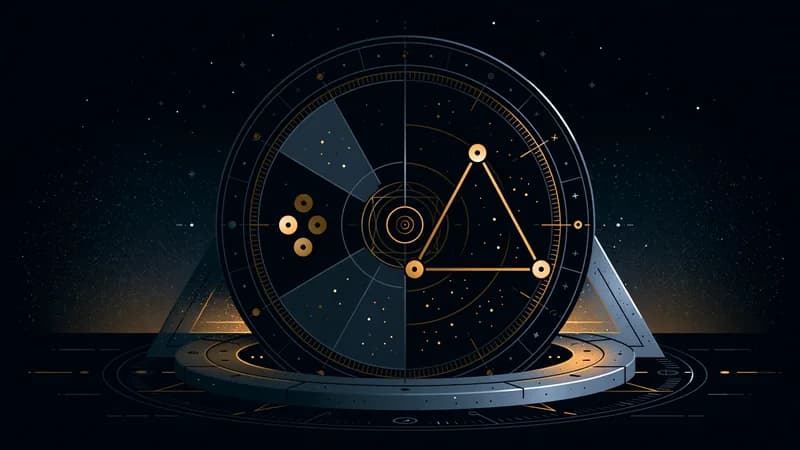
A grand trine forms when three planets sit roughly 120° apart, creating an equilateral triangle that spans the chart. Because the points of the triangle land in signs of the same element, a grand trine usually carries a single elemental flavor — a fire grand trine, an earth grand trine, an air grand trine, or a water grand trine — and that element describes the kind of ease the pattern provides.
The hallmark of a grand trine is natural flow. The three planets reinforce one another with the smoothness of the trine aspect, producing talents that feel effortless and circumstances that seem to fall into place without struggle. A fire grand trine might lend natural confidence and creative spark; an earth grand trine, a steady practical competence; an air grand trine, an easy facility with ideas and communication; a water grand trine, deep intuitive and emotional attunement. People with a grand trine often take the gift for granted precisely because it has always been there.
That very ease is also the pattern's hidden challenge. Energy that flows without resistance offers little motivation to develop it. The risk of a grand trine is complacency — a tendency to coast on natural ability rather than push it toward achievement. Trines open doors but do not force anyone through them. The most productive way to live with a grand trine is to treat its gifts as a foundation to build on deliberately, not a destination to rest in. Frequently it takes a more challenging aspect elsewhere in the chart to supply the friction that turns the grand trine's raw talent into something realized.
The T-Square: Tension That Drives
A T-square is built from two planets in opposition, both of which form a square to a third planet. On the chart wheel the figure looks like a capital T: the opposition stretches across as the horizontal bar, and the third planet sits at the base, squaring both ends. That third planet is the apex, or focal planet, and it is the key to reading the entire pattern.
Where the grand trine offers ease, the T-square offers friction — and that friction is precisely what makes it valuable. The opposition creates an unresolved tension between two competing drives, and because both also square the apex, all that pressure funnels into the focal planet. The result is a configuration that constantly demands a response. People with a prominent T-square often describe a sense of being pushed, of facing recurring challenges in the apex planet's domain that simply will not let them stand still.
That pressure is a powerful engine for achievement. The discomfort of a T-square motivates effort, problem-solving, and persistence in ways that smoother configurations rarely do. Many high achievers carry a T-square, and the apex planet frequently points to the very area where they accomplish the most, having been forced to develop it under sustained strain. The growth path lies in channeling the energy through the apex constructively rather than letting it spill out as frustration or repeated conflict. One useful technique is to consciously develop the empty point opposite the apex — the open leg of the figure — which offers a release valve for the accumulated tension.
Grand Cross, Yod, and Other Figures
Beyond the three most common patterns, a handful of less frequent figures appear often enough to be worth knowing. They tend to be rarer because they require more planets to fall into exact relationships, which also makes them especially prominent when they do occur.
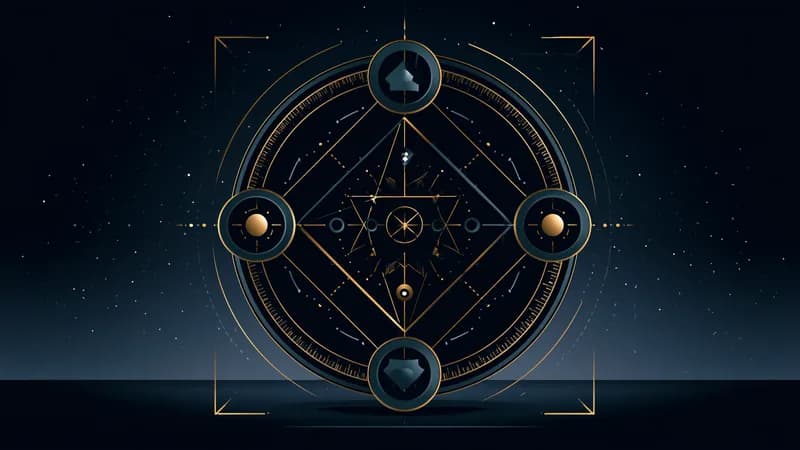
The grand cross is essentially a doubled T-square: four planets arranged so that they form two oppositions crossing at right angles, generating four squares in total. The figure makes a complete cross across the chart, often with one planet in each of the four signs of a single modality. A grand cross carries enormous tension distributed in all four directions, which can feel like being pulled simultaneously by competing demands. But it also confers tremendous resilience and drive; people who learn to integrate it become capable of sustained, multifront effort that would overwhelm others.
The yod, sometimes called the "finger of fate," has a very different texture. It forms when two planets in a sextile both make a quincunx (150°) to a third planet at the apex. The two quincunxes create a subtle, persistent sense of adjustment focused on the apex planet, as if that point of the chart is being singled out for a specialized purpose. Yods are often experienced as a recurring call to refine or redirect the apex planet's energy. A kite, for example, is a grand trine with a fourth planet opposing one of its points, which adds a focal outlet that gives the trine's easy talent somewhere to aim. A mystic rectangle weaves two oppositions together with trines and sextiles, balancing tension and flow in a single closed figure. Other configurations exist as well, but the grand cross and the yod are the two you are most likely to encounter alongside the major patterns, and recognizing them is enough to read the great majority of charts.
How Patterns Color the Whole Chart
A chart pattern is never read in a vacuum. Its meaning depends entirely on which planets, signs, and houses it involves, and on how it relates to the chart's core placements. A T-square anchored on the planet of communication tells a different story than one anchored on the planet of discipline, and a stellium in the house of career means something quite different from the same cluster in the house of home and family. The pattern supplies the shape; the placements supply the content.
This is why patterns are best interpreted in conversation with the foundational pieces of identity. The signs of the Sun, Moon, and rising — the core trio explored in our guide to the Sun, Moon, and rising signs — set the tone that a pattern then amplifies or complicates. A grand trine that includes the Sun reinforces a person's central sense of self with natural ease; a T-square that squares the Moon turns emotional life into a driving force. The same geometric figure reads very differently depending on which essential placements it touches.
The deeper point is that no single feature defines a chart. Patterns, aspects, signs, houses, and angles all interact, and an interpretation only becomes accurate when it holds them together as one whole. If you are new to how all these layers fit, our overview of what a natal chart contains is a good place to see how the pieces assemble into a complete picture.
A TriMoon Natal Chart Interpretation identifies the patterns in your chart and explains what they mean for you — from your exact birth date, time, and place. Seeing your stelliums, trines, and squares mapped against your core placements is often the moment the whole chart starts to make sense as a single, coherent story.
This article was written by AI and has not been reviewed by a person. The astronomy behind it is TriMoon's own precise ephemeris data — not generic horoscopes.