The Progressed Lunation Cycle: The Thirty-Year Rhythm of Your Life
September 26, 2026 · 9 min read · The TriMoon Team
 AI-generated. Written by a model and not reviewed by a person.
Read your progressed chart and solar arcs for twelve months from a month you choose — $25, one-time.
Get your Progressions report — $25 →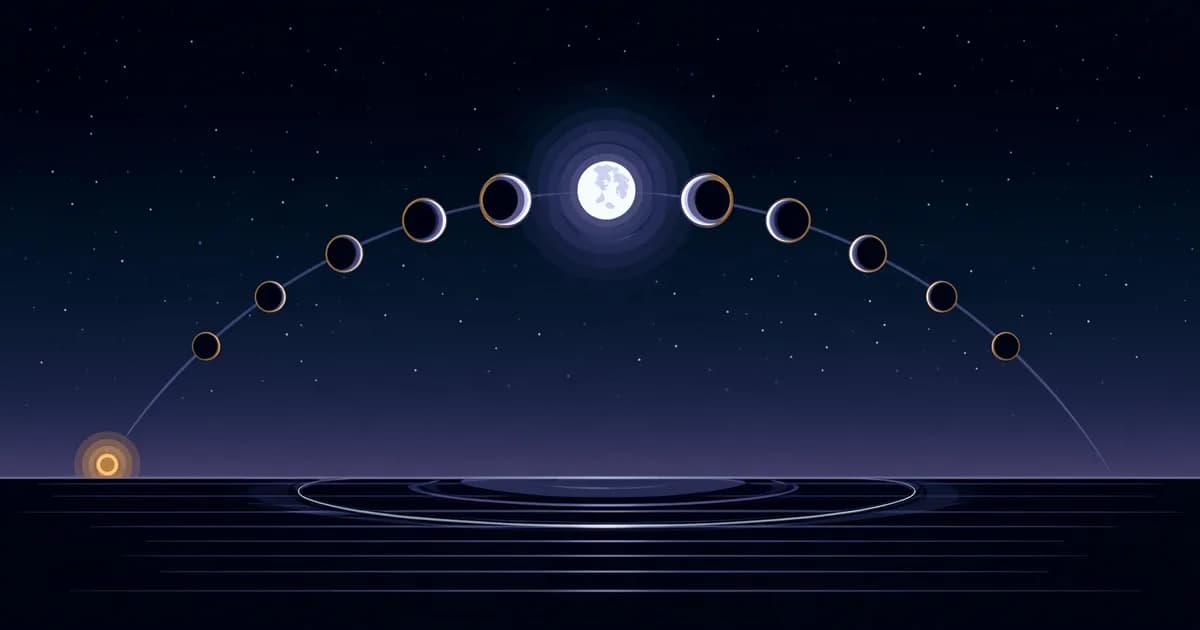
The phases of the Moon repeat every month in the sky, but in your progressed chart the same cycle takes about thirty years. The progressed lunation cycle maps the long rhythm of beginning, building, culmination and release in a life.
The Sun and Moon, Slowed Down
Everyone knows the monthly rhythm of the Moon: the dark New Moon, the growing crescent, the Full Moon opposite the Sun, and the waning back to darkness. That cycle is simply the changing angle between the Sun and the Moon as the Moon travels around the Earth, and it repeats about every twenty-nine and a half days.
In secondary progressions, each day after birth stands for a year of life. Apply that rule to the lunar cycle and something striking happens: the monthly rhythm stretches into a cycle of roughly twenty-nine and a half years. The progressed Moon advances around a degree a month and the progressed Sun about a degree a year, so the angle between them opens and closes slowly, tracing the same sequence of phases as the sky does every month — New, Crescent, First Quarter, Gibbous, Full, Disseminating, Last Quarter and Balsamic — over three decades instead of four weeks.
This is the progressed lunation cycle. It was popularised in the twentieth century by the astrologer Dane Rudhyar, who read the Sun–Moon cycle as a model of how any process grows: a seed is planted, it takes root, it meets resistance, it matures, it bears fruit, it shares what it has produced, it reorients and finally it clears the ground for the next seed. Rudhyar's framing is now standard in progressed work, and it is one of the most useful long-range tools in all of astrology because it does not depend on any single event. It describes the shape of a period rather than its contents.
Most people live through two or three full progressed lunation cycles. Each begins with a progressed New Moon, when the progressed Moon catches up with the progressed Sun, and each passes through a progressed Full Moon around fifteen years later. Where these moments fall in your life is fixed by your birth chart: someone born just after a New Moon starts life at the beginning of a cycle, while someone born just before one meets their first progressed New Moon in early childhood.
The cycle's phases describe tone rather than circumstance. They tell you whether this is a period for starting, for building, for harvesting or for letting go — and knowing that alone can reframe a stretch of years that otherwise feels puzzling.
Eight Phases of Roughly Three and a Half Years
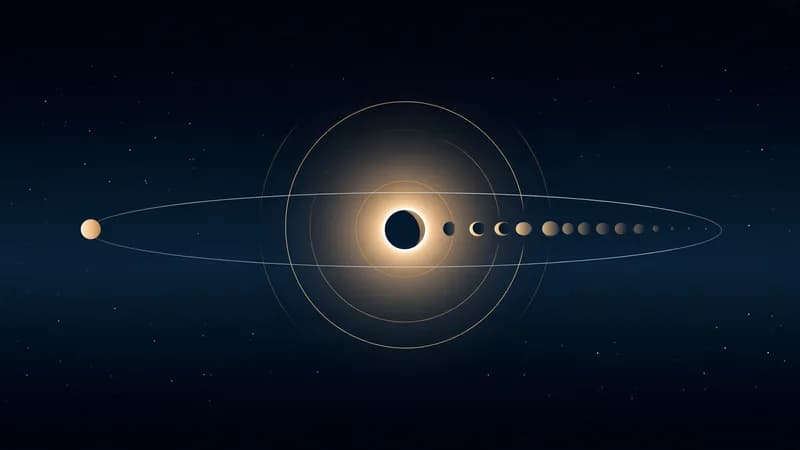
The cycle is divided into eight phases of forty-five degrees each. Because the progressed Moon's speed varies, each phase lasts roughly three and a half to four years. In the approach Rudhyar popularised, each phase begins at its defining angle — the New Moon phase starts at the conjunction, the First Quarter phase at the waxing square, and so on — and runs until the next one begins.
- New Moon (0°–45°): a seed is planted. New directions emerge, often without a clear picture of where they lead. Instinct runs ahead of understanding, and this is a time to follow what feels alive rather than to demand a plan.
- Crescent (45°–90°): the new direction has to push against the old. Momentum builds, but so does the pull of familiar habits and obligations. Commitment to what began at the New Moon is tested and strengthened.
- First Quarter (90°–135°): action and construction. Structures are built, decisions are made and obstacles are met head-on. This is often a busy, externally demanding phase.
- Gibbous (135°–180°): refinement. What has been built is analysed, improved and prepared for its full expression. There is often a sense of striving toward something that is almost, but not quite, ready.
- Full Moon (180°–225°): culmination and visibility. The purpose of the cycle becomes clear, sometimes through relationships and other people's responses. What has been growing is now in plain view, for better or worse.
- Disseminating (225°–270°): sharing the harvest. What has been learned or achieved is passed on — taught, published, applied more widely. Meaning becomes more important than achievement.
- Last Quarter (270°–315°): reorientation. Structures that served the cycle begin to feel limiting. There is a turning away from old forms and a questioning of commitments that no longer fit.
- Balsamic (315°–360°): release and preparation. The cycle winds down; there is often a need for rest, retreat and completion before the next seed can be planted.
These phase descriptions are intentionally broad. Their value lies in how they frame the years around them: an ambitious plan that stalls during a Balsamic phase may simply be early, and a sense of exposure during a Full Moon phase may be the natural visibility of work that has matured.
The Progressed New Moon: Planting a Chapter
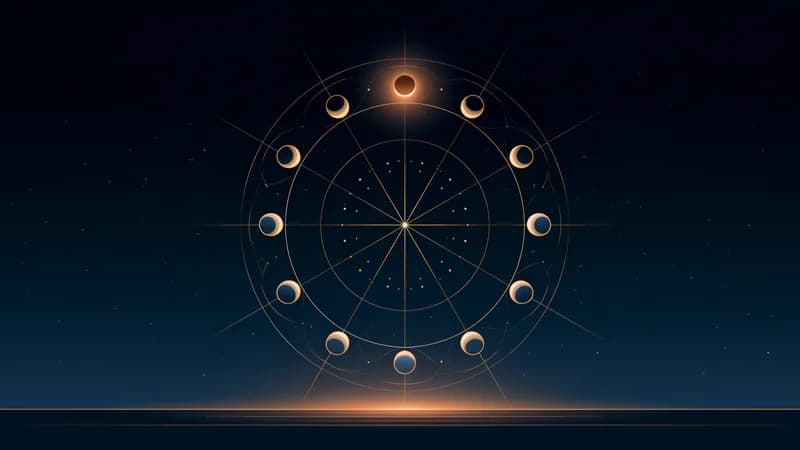
The progressed New Moon — the moment the progressed Moon conjoins the progressed Sun — is the most closely watched point in the cycle. It marks the start of a new thirty-year chapter, and the sign and natal house where it falls describe the kind of seed being planted.
What tends to characterise the period around a progressed New Moon is not so much a dramatic event as a change of orientation. People often describe it as a time when old priorities fall away before new ones have clearly formed — a kind of fertile uncertainty. Relationships, work or living situations may change, but the more reliable signature is internal: a feeling that something new has begun, even if it is not yet clear what it is.
The sign of the progressed New Moon describes the character of the new cycle. A New Moon in Capricorn suggests a cycle oriented toward responsibility, mastery and long-term achievement; one in Pisces, a cycle more attuned to imagination, compassion or spiritual questions. The natal house where it falls points to the area of life in which the new cycle is rooted — the second house suggests resources and self-worth, the seventh partnership, the tenth vocation.
It is common to feel the approach of a progressed New Moon during the final Balsamic years, as the previous cycle's concerns lose their hold. The New Moon itself then works less like a starting pistol and more like a quiet dawn: something that is easy to recognise in hindsight and hard to see while it is happening. For that reason, noting the date and your circumstances at the time can be valuable. Many people find that the seeds of their next fifteen years were present, in small form, around that moment.
If you know when your last progressed New Moon occurred, it is worth asking what began around then — a relationship, a direction, a way of seeing yourself. The answer often reveals the thread that the rest of the cycle has been developing.
The Progressed Full Moon: Seeing What Has Grown
About fifteen years after the progressed New Moon, the progressed Moon reaches the opposition to the progressed Sun: the progressed Full Moon. If the New Moon planted the seed, the Full Moon shows what it has become.
The Full Moon phase is associated with clarity, visibility and awareness. It tends to bring the purpose of the current cycle into focus, often through relationships and the reactions of other people. Work that has been developing quietly may become public; commitments made years earlier may reach a point of fulfilment or of reckoning. Because the Full Moon is an opposition, it often brings a sense of seeing yourself reflected — recognising, through others, what you have been building.
This can be a deeply satisfying phase, and it can also be uncomfortable. When what has grown is not what you hoped for, the clarity of the Full Moon can feel like exposure. It is worth remembering that awareness is the point of the phase, not judgement. Seeing a pattern clearly is what makes the second half of the cycle — the sharing, reorienting and releasing — possible.
Some practical observations about the progressed Full Moon:
- It is a period, not a day. The exact opposition is a single point, but the phase it begins lasts three and a half years or more, and its themes build noticeably in the year before.
- The house axis matters. The progressed Full Moon falls across two opposite houses of your natal chart, and the tension between those areas of life — home and career, self and partner, resources and shared commitments — is often where its awareness arrives.
- It is a turning point, not an ending. After the Full Moon the cycle moves into its waning half, where the emphasis shifts from building toward sharing and integrating. Knowing that the energy is about to change direction helps avoid pushing on in the same way out of habit.
Read alongside the progressed New Moon that preceded it, the Full Moon completes a picture: what was planted, and what it has become.
The Balsamic Phase: Clearing the Ground
The final phase of the cycle, the Balsamic phase, begins when the progressed Moon is forty-five degrees behind the progressed Sun and lasts until the next progressed New Moon. It is the least understood of the eight phases and, in many ways, the most valuable to recognise.
The Balsamic phase is associated with endings, release and preparation. The concerns of the old cycle loosen their hold. Roles, relationships or ambitions that once felt central may begin to feel complete. There is often a pull toward rest, retreat and reflection, and a reduced appetite for starting new projects. People sometimes describe it as a time of feeling out of step, or of letting go of identities they had worn for years.
Read without context, those experiences can be alarming. Read in context, they are the natural closing of a cycle that began nearly three decades earlier. Rudhyar called the Balsamic phase a time of seed: the harvest of the old cycle is distilled into what will be carried forward, and the rest is released. The seed for the next New Moon is formed here, even though it cannot yet be planted.
A few practical ways to meet this phase well:
- Finish rather than start. Projects that complete something tend to go better than projects that launch something wholly new. That does not forbid new beginnings; it suggests they may need to wait for the New Moon to find their footing.
- Make room. Clearing out possessions, commitments or habits is often more rewarding than adding to them.
- Pay attention to what persists. Whatever still feels meaningful after everything else has loosened is likely to be part of the next cycle.
- Rest without guilt. A Balsamic phase is not a failure of ambition. It is the part of the cycle in which ambition is renewed.
For many people, knowing they are in a Balsamic phase is a relief in itself. It turns a period of apparent stagnation into what it usually is: the quiet preparation that makes the next beginning possible.
Finding Where You Stand Now
Your current progressed lunation phase depends on the angle between your progressed Moon and progressed Sun at this moment, which in turn depends on your birth chart and your age. Unlike the monthly Moon phase, it cannot be read from a calendar; it has to be calculated from your own birth data. Once you know it, though, it becomes one of the steadiest reference points in your chart, because it changes only every few years.
To use it well, look at three things together:
- The current phase tells you the tone of the present period — starting, building, culminating, sharing, reorienting or releasing.
- The last progressed New Moon — its date, sign and natal house — tells you what this cycle is about. Many people find that simply knowing the date helps them recognise the thread they have been following since then.
- The next phase change tells you when the tone is likely to shift, which is useful for planning your energy over the coming years.
The phase also gives a useful frame for the faster pieces of the progressed chart. The progressed Moon's two-and-a-half-year chapters sit inside it, as do the individual progressed aspects that come and go. A progressed Moon in an ambitious sign means something different in a First Quarter phase, when building is natural, than in a Balsamic phase, when completion is. Reading the two together gives a far richer picture than either alone.
As with every part of progressions, the phases describe tendencies of growth rather than fixed outcomes. A Full Moon phase does not guarantee recognition, and a Balsamic phase does not forbid new ventures. They describe the current of a period; you still decide how to swim in it.
If you would like to know where you stand in your own cycle, the TriMoon Progressions Report includes a long-arc section on your progressed Sun and your current progressed lunation phase — where in the roughly thirty-year cycle you are, and what that phase tends to ask for — alongside the progressed Moon's chapter and the dated contacts for the twelve months you choose.
This article was written by AI and has not been reviewed by a person. The astronomy behind it is TriMoon's own precise ephemeris data — not generic horoscopes.