What Are Moon Phases and How Do They Affect You?
April 11, 2026 · 8 min read · TriMoon.world
 AI-generated. Written by a model and not reviewed by a person.
Get the Lunar Calendar's daily guidance free for 7 days, then $5 / mo — cancel anytime.
Start your free 7-day trial →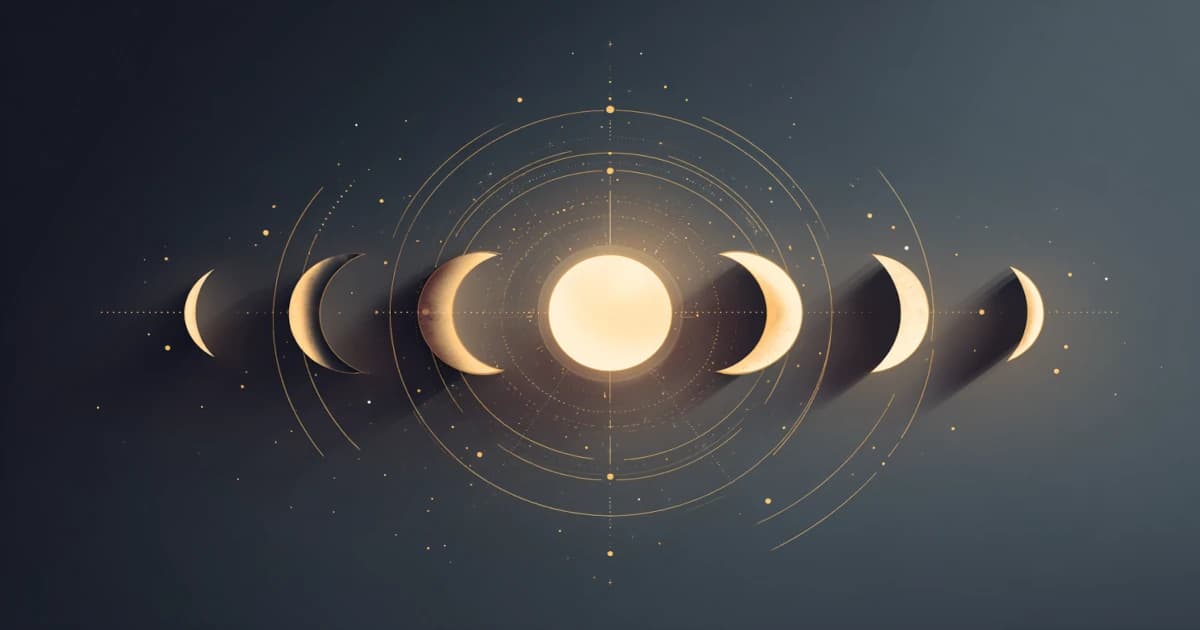
The Moon completes a full cycle roughly every 29.5 days, moving through eight distinct phases that have guided human activity for millennia. Understanding these lunar phases can help you align your energy, improve your planning, and make more informed decisions in everyday life.
Understanding the Lunar Cycle
Every 29.5 days, the Moon completes a full orbit around Earth, cycling through a predictable sequence of illumination changes that we call moon phases. This lunar cycle has served as humanity's oldest calendar — long before clocks and digital planners, farmers planted by the Moon, sailors navigated by its light, and entire civilizations structured their festivals around its rhythm.
What makes the lunar cycle so consistent is pure celestial mechanics. As the Moon orbits Earth, the Sun illuminates different portions of the side facing us. The result is a gradual waxing (growing) and waning (shrinking) of visible light that repeats with remarkable precision. While the average synodic month is 29.53 days, individual cycles can vary by several hours due to the Moon's slightly elliptical orbit.
Today, the lunar cycle remains relevant far beyond astronomy. Research suggests that moonlight intensity, gravitational pull, and the rhythmic nature of the cycle itself may influence biological patterns — from marine animal reproduction to human sleep quality. Whether you approach it from a scientific, cultural, or practical standpoint, understanding the Moon's phases gives you a framework for working with one of nature's most reliable rhythms.
The Eight Moon Phases
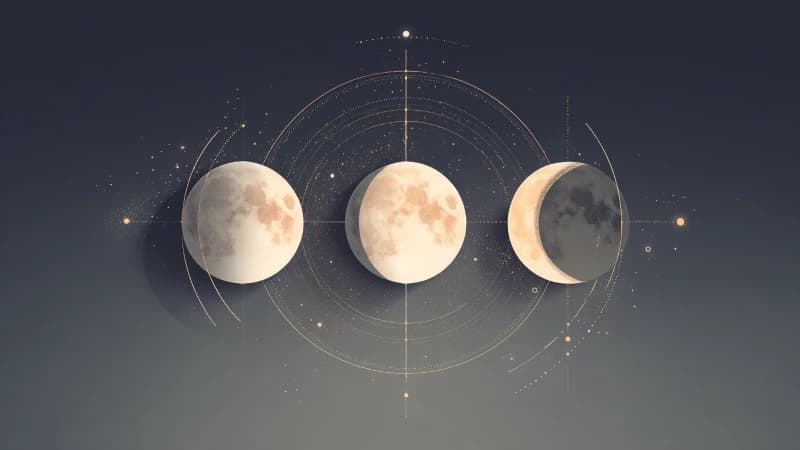
The lunar cycle divides naturally into eight phases, each representing roughly 3.7 days of the Moon's journey. Learning to recognize them is simpler than it looks — once you understand the pattern, you can identify the current phase just by glancing at the night sky.
The New Moon marks the cycle's beginning. The Moon sits between Earth and the Sun, with its illuminated side facing away from us. The sky appears moonless, making it the darkest night of the cycle. Astronomically, this is the moment of conjunction — when the Sun and Moon share the same ecliptic longitude.
During the Waxing Crescent, a thin sliver of light appears on the Moon's right side (in the Northern Hemisphere). This phase begins a day or two after the New Moon and represents the first visible sign that a new cycle is underway.
The First Quarter — often called a half moon — shows exactly 50% illumination on the right side. Despite the name, you're only one quarter through the cycle. This is a moment of balance between the dark and light halves.
The Waxing Gibbous phase fills in most of the Moon's face. More than half but not yet fully illuminated, this phase builds anticipation toward the Full Moon. The word "gibbous" comes from Latin, meaning "humpbacked" — describing the rounded shape of the lit portion.
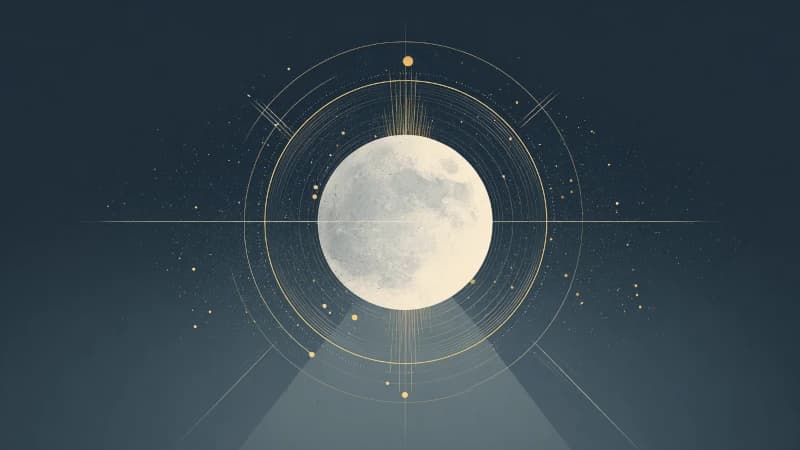
The Full Moon arrives when Earth sits between the Sun and Moon, fully illuminating the lunar surface we see. This is the brightest night of the cycle, and the only time lunar eclipses can occur. Full Moons rise at sunset and set at sunrise, making them visible throughout the entire night.
After the peak, the Waning Gibbous begins reducing illumination from the left side. The Moon now rises later in the evening and remains visible into the morning hours.
The Last Quarter (or Third Quarter) mirrors the First Quarter with 50% illumination — but now on the left side. You're three-quarters through the cycle, and the Moon rises around midnight.
Finally, the Waning Crescent shows just a thin sliver on the left, visible in the pre-dawn sky. This phase completes the cycle before the next New Moon begins the process again. In astrology the same eight-phase pattern turns up on a far slower clock, stretched over about thirty years of a life: the progressed lunation cycle.
How Moon Phases Affect Daily Life
The question of whether the Moon influences human behavior has fascinated researchers and ordinary people alike for centuries. While the full picture is still emerging, several areas show credible connections between the lunar cycle and daily experience.
Sleep patterns are among the best-studied effects. Some sleep researchers have reported that people take longer to fall asleep and sleep less soundly around the Full Moon, even without visible moonlight. Subsequent studies have produced mixed results, but the pattern continues to attract serious scientific inquiry.
Energy and mood fluctuations across the lunar cycle are reported consistently in surveys, though the mechanisms remain debated. Many people describe feeling more energized and sociable around the Full Moon, while the days surrounding the New Moon often bring a quieter, more introspective quality. Whether this is physiological, psychological, or simply the result of paying attention to natural rhythms, the practical experience is real for many individuals.
Decision-making and productivity may also follow lunar patterns, at least indirectly. If your sleep and energy fluctuate with the Moon, it stands to reason that your cognitive sharpness does too. Some financial researchers have even examined stock market performance relative to lunar phases, finding small but statistically notable patterns in investor sentiment.
The important takeaway is not that the Moon controls your life, but that awareness of natural cycles — lunar or otherwise — can help you plan more thoughtfully. Recognizing that your energy might dip at certain times allows you to schedule demanding tasks when you're naturally more alert.
Working With the Lunar Rhythm
Regardless of what drives the connection between Moon phases and human experience, millions of people find practical value in aligning their activities with the lunar cycle. Here is a straightforward framework for doing so — no mysticism required, just pattern-based planning.
New Moon (Days 1–3): Set intentions and plan. The New Moon is widely considered the best time for goal-setting and starting fresh. With the sky at its darkest, this phase naturally encourages reflection. Use it to clarify what you want to accomplish in the coming weeks, outline new projects, or commit to a change you've been considering.
Waxing Crescent to First Quarter (Days 4–7): Take initial steps. As the Moon's light grows, channel that building energy into action. Start new habits, make first contact on a business proposal, or begin creative work. This phase favors initiative — small, concrete steps that set larger plans in motion.
Waxing Gibbous (Days 8–10): Refine and adjust. Momentum is building. Review what you've started, troubleshoot problems, and make improvements. This is a productive phase for editing, iterating, and fine-tuning rather than starting entirely new ventures.
Full Moon (Days 11–15): Harvest and connect. The Full Moon brings peak visibility — literally and figuratively. It's a natural time for completing projects, celebrating achievements, and social connection. Many people find their communication skills peak around the Full Moon, making it favorable for presentations, negotiations, and important conversations.
Waning Gibbous (Days 16–18): Share and teach. As the light begins to decrease, turn outward. Share what you've learned, mentor others, or distribute the results of your recent work. This phase is well-suited to generosity and dissemination.
Last Quarter to Waning Crescent (Days 19–29): Release, rest, and reflect. The waning half of the cycle is for letting go. Finish lingering tasks, clear clutter, end commitments that no longer serve you, and give yourself permission to rest. Pushing hard during this phase often feels like swimming against the current. Better to use it for tying up loose ends and preparing mentally for the next cycle.
Moon Phases Across Cultures
Virtually every civilization in recorded history has developed its own relationship with the lunar cycle, and many of these traditions remain vibrant today.
In East Asian cultures, the lunar calendar continues to structure major holidays. Chinese New Year, the Mid-Autumn Festival, and Korean Chuseok are all timed to specific Moon phases. The Full Moon of the eighth lunar month holds special significance as a symbol of reunion and completeness — families gather, share mooncakes, and contemplate the illuminated sky together.
The Islamic calendar is purely lunar, with each month beginning at the first sighting of the Waxing Crescent after the New Moon. This means that major observances like Ramadan, Eid al-Fitr, and Hajj migrate through the solar year over a roughly 33-year cycle, keeping the faith intimately connected to the Moon's actual behavior rather than a fixed seasonal schedule.
Indigenous traditions across the Americas, Africa, and Oceania frequently name each Full Moon after seasonal markers — the Harvest Moon, the Strawberry Moon, the Snow Moon. These names are not mere folklore; they encode practical agricultural and ecological knowledge, reminding communities when to plant, when to fish, and when to prepare for changing weather.
In European folk tradition, the Moon governed planting schedules, timber cutting, and even hair trimming. While some of these practices have faded, biodynamic farming — which times agricultural activities to the lunar cycle — still has committed practitioners, who report effects on germination and soil health.
What all these traditions share is a recognition that the Moon's cycle provides a useful structure for organizing human activity. The specific cultural expressions differ, but the underlying principle — that paying attention to the Moon helps people live more deliberately — is remarkably universal.
Tracking Moon Phases for Better Decisions
Keeping track of the Moon's cycle is easier today than at any point in history. A simple wall calendar with lunar markers can be enough to get started — just note the New and Full Moon dates each month and observe how your energy and focus shift across the cycle.
For a more detailed approach, consider maintaining a brief lunar journal. Spend 30 seconds each day noting the current phase alongside your mood, energy level, and sleep quality. After two or three complete cycles (roughly two to three months), you'll likely notice personal patterns that no general guide can provide. Your individual rhythm matters more than any one-size-fits-all prescription.
Digital tools make this process even more accessible. The TriMoon Lunar Calendar offers precise daily lunar data, helping you see at a glance where you are in the current cycle and plan accordingly. Rather than relying on generic horoscope advice, having accurate astronomical timing at your fingertips allows you to build your own evidence-based relationship with the lunar rhythm.
The key is consistency. Like any habit-tracking practice, the value of lunar awareness compounds over time. You may not notice dramatic changes in the first week, but over several months, the accumulated self-knowledge — knowing when you tend to be sharpest, when you need rest, when you're most creative — becomes a genuinely useful planning tool. And when you are ready to go beyond the shared sky, the same practice deepens naturally: a daily transit reads each day against your own natal chart — the personalized edition of everything a lunar calendar tracks.
The Moon has been humanity's companion since before we had language to describe it. Whether you see it as a source of gravitational influence, a psychological anchor, or simply a beautiful and reliable timekeeper, there is something grounding about syncing your attention to its cycle. In a world of endless digital noise, the quiet reliability of the lunar rhythm offers a welcome alternative.
This article was written by AI and has not been reviewed by a person. The astronomy behind it is TriMoon's own precise ephemeris data — not generic horoscopes.