Elemental & Modality Chemistry in Synastry
July 7, 2026 · 8 min read · The TriMoon Team
 AI-generated. Written by a model and not reviewed by a person.
Lay two charts side by side and see how you connect — $25, one-time.
Get your Synastry report — $25 →
How fire, earth, air and water mix across two charts — plus cardinal, fixed and mutable energy — shapes a couple's chemistry, tempo and easy frictions.
The Two Quiet Engines Behind Chemistry
When people talk about what makes two charts "click," they usually reach for planets and aspects. Those matter, and we cover them in synastry aspects explained. But underneath the named contacts there are two quieter, more pervasive patterns doing a lot of the work: the elements (Fire, Earth, Air, Water) and the modalities (Cardinal, Fixed, Mutable). Together they describe not just what two people are drawn to, but how they move through the world — fast or slow, steady or shifting, head-first or heart-first.
Every placement in a chart carries an element and a modality. Add them up across both partners and you get a feel for the relationship's overall temperature and tempo. This is less about a single dramatic aspect and more about the climate the two of you live in day to day.
A quick orientation before we go further:
- Fire (Aries, Leo, Sagittarius) — warmth, drive, enthusiasm, spontaneity.
- Earth (Taurus, Virgo, Capricorn) — steadiness, practicality, the body, follow-through.
- Air (Gemini, Libra, Aquarius) — ideas, conversation, perspective, social connection.
- Water (Cancer, Scorpio, Pisces) — feeling, intuition, depth, emotional attunement.
None of these is "better" for love. The point of reading them in synastry is to notice where two people naturally meet and where they speak slightly different dialects — so the differences become something to work with rather than puzzle over. If you're new to the whole idea of comparing two charts, start with what synastry is and come back.
Same Element: Easy Fluency, and Its Blind Spot
When two people lead with the same element, there's often an immediate sense of getting it. You don't have to explain your baseline; it's shared. Two strongly Water people may read each other's moods before a word is spoken. Two Air-rich partners can talk for hours and call it a perfect evening. Fire and Fire bring shared momentum; Earth and Earth share a love of the tangible and the reliable.
This fluency is a real gift, and it tends to make the early days feel comfortable. The thing to stay curious about is the shared blind spot: an element that's doubled is also an element that goes unchallenged.
- Fire + Fire can run hot and burn out, or compete for the spotlight, with no cooler voice in the room to say "let's pace this."
- Earth + Earth can get so practical and routine-bound that spontaneity and emotional risk quietly drop off the calendar.
- Air + Air may live in the realm of ideas and analysis and skip the harder work of feeling things all the way through.
- Water + Water can merge so deeply that boundaries blur, and small moods become big weather systems for both people.
None of this is a problem to be solved so much as a tendency to be aware of. Same-element couples often do best when each person consciously cultivates a bit of what the pair is missing — a Fire couple agreeing on rest, a Water couple agreeing to name things out loud. The ease is real; it just benefits from a little deliberate balance.
Complementary Pairs: Fire–Air and Earth–Water
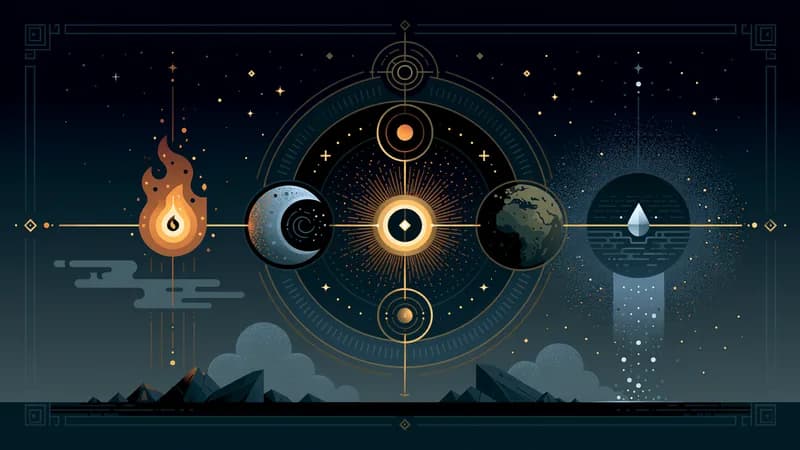
Some element combinations are traditionally described as naturally supportive — they feed each other rather than fight. The two classic complementary pairs are Fire with Air and Earth with Water.
Fire and Air tend to amplify one another in a good way. Air brings ideas, language and perspective; Fire brings the heat and the will to act on them. Conversation sparks action, and action gives the conversation somewhere to go. A Fire-leaning partner can feel genuinely seen by an Air partner who finds their enthusiasm interesting rather than too much, and Air can feel energized by Fire's willingness to actually do the thing they've been theorizing about. The watch-point is restlessness: two such mobile elements can keep generating new plans without landing any of them, so a shared habit of finishing what they start goes a long way.
Earth and Water nourish each other in a quieter register. Water brings feeling, intuition and emotional depth; Earth brings containment, steadiness and a place for those feelings to take root. Think of how soil holds water so something can grow — Earth gives Water's tides a shape, and Water keeps Earth from going dry and over-pragmatic. This pairing often feels safe and grounding to both people. The watch-point here is the opposite of the Fire–Air one: too much comfort can tip into stagnation, so a little intentional novelty keeps it alive.
It's worth saying plainly: "complementary" describes a tendency toward easy support, not a guarantee. Plenty of Fire–Air and Earth–Water couples have to work at things, and plenty of so-called "hard" pairings build wonderful lives. The elements set a starting texture; the people decide what to make of it.
The Classic Frictions: Fire–Water and Earth–Air
If Fire–Air and Earth–Water are the famously easy mixes, then Fire–Water and Earth–Air are the famously interesting ones — the combinations that ask a little more translation. Friction here is not a verdict and certainly not a sentence; it's simply two different operating systems that have to learn each other's commands. Some of the most magnetic, growthful relationships live in exactly this territory.
Fire and Water is the meeting of heat and feeling. Fire moves fast, speaks directly and processes by acting; Water moves in tides, feels first and needs time to surface what's going on. To Fire, Water can seem to brood or hold back; to Water, Fire can seem to charge ahead without noticing the emotional undercurrent. The work — and it's very doable — is pace and care: Fire slowing down to ask how the other person actually feels, Water trusting Fire enough to say it sooner. When that loop is established, Fire's warmth can be deeply reassuring to Water, and Water's depth gives Fire's energy real meaning.
Earth and Air is the meeting of the concrete and the conceptual. Earth wants the plan, the practical step, the thing you can hold; Air wants the idea, the options, the conversation. Earth can experience Air as scattered or all-talk; Air can experience Earth as rigid or stuck in the details. Yet each holds exactly what the other under-uses. Air can help Earth lift out of a rut and see new possibilities; Earth can help Air turn brilliant ideas into something that actually lands in the world. The bridge is mutual respect for the other mode — Earth taking the ideas seriously, Air honoring that follow-through is its own kind of intelligence.
A few gentle reminders for any "friction" pairing:
- The difference is a feature as much as a bug — it's often what made you interesting to each other.
- Name the pattern out loud together; "I think we're doing the Fire/Water thing again" defuses a lot.
- Aim for translation, not conversion. The goal isn't to turn your partner into your element.
Modality: The Tempo and Direction of the Relationship
If elements describe the flavor, modalities describe the rhythm — how each person initiates, sustains and adapts. There are three, and the mix across two charts says a lot about how a couple handles starting things, holding things and changing things.
- Cardinal (Aries, Cancer, Libra, Capricorn) — initiators. They start, lead, launch, set direction.
- Fixed (Taurus, Leo, Scorpio, Aquarius) — sustainers. They commit, stabilize, hold the line, see things through.
- Mutable (Gemini, Virgo, Sagittarius, Pisces) — adapters. They adjust, improvise, bend, keep things flexible.
A healthy relationship usually needs a bit of all three: someone to get things going, someone to keep them going, and someone to flex when life changes the plan. When two charts together cover the spread, the couple can start, sustain and adapt without too much strain. When the mix is lopsided, that's not a problem — it's just useful self-knowledge about where to put a little extra intention.
Modality and element work together, too. A Fixed Water emphasis feels very different from a Mutable Water one — the first holds feelings deeply and for a long time, the second moves through them more fluidly. Reading both layers at once is closer to how a relationship actually feels than reading either alone, and it's a big part of why two "Water couples" can have completely different chemistry.
Working With Your Modality Mix
Here's how the common modality combinations tend to play out across two charts — again, as tendencies you can lean into or balance, never as fixed scripts.
Cardinal + Cardinal. Two initiators. There's wonderful drive and momentum here; you both start things and set ambitious direction. The classic snag is two people wanting to lead, which can feel like a tug-of-war over whose plan wins. It works beautifully when you divide territory — you steer this, I'll steer that — and remember that not every decision needs a captain.
Fixed + Fixed. Two sustainers. This pairing can be remarkably loyal, stable and committed; once you're in, you're in. The flip side is that two people who both "hold the line" can dig into a standoff, where neither bends and a small disagreement ossifies. The growth edge is practicing flexibility on purpose — treating a willingness to move first as strength, not surrender.
Mutable + Mutable. Two adapters. Lovely flow, easy adjustment, very little rigidity — you bend around each other and around life. The watch-point is that sometimes nobody plants a flag, so plans stay vague and decisions drift. A shared agreement to actually commit to a choice helps a lot.
Mixed modalities. Most couples are some blend, and that's often the smoothest setup of all: the Cardinal partner gets things moving, the Fixed partner keeps them steady, the Mutable partner smooths the bumps. The work is appreciating the role you each play instead of reading it as a flaw — the "slow" partner is your stability; the "flighty" one is your adaptability.
A few practices that help any modality mix:
- Notice who naturally starts, who sustains and who adapts — then thank each other for it rather than resenting it.
- When you're stuck, ask which mode the moment needs: does this need launching, holding, or flexing?
- Let the partner with the matching strength take the lead for that task, and trade off as the task changes.
Elements and modalities give you a warm, plain-language map of your shared temperature and tempo — but they're only one layer. The luminaries and the rising sign add another; that's the focus of Sun, Moon & Rising in synastry. If you'd like all of these layers read together for your specific two charts, our personalized synastry report brings them into a single clear picture. However the elements fall between you, the chemistry is something the two of you build together, with consent and care, one ordinary day at a time.
This article was written by AI and has not been reviewed by a person. The astronomy behind it is TriMoon's own precise ephemeris data — not generic horoscopes.