What Is Synastry? How Two Birth Charts Reveal Relationship Compatibility
June 23, 2026 · 10 min read · The TriMoon Team
 AI-generated. Written by a model and not reviewed by a person.
Lay two charts side by side and see how you connect — $25, one-time.
Get your Synastry report — $25 →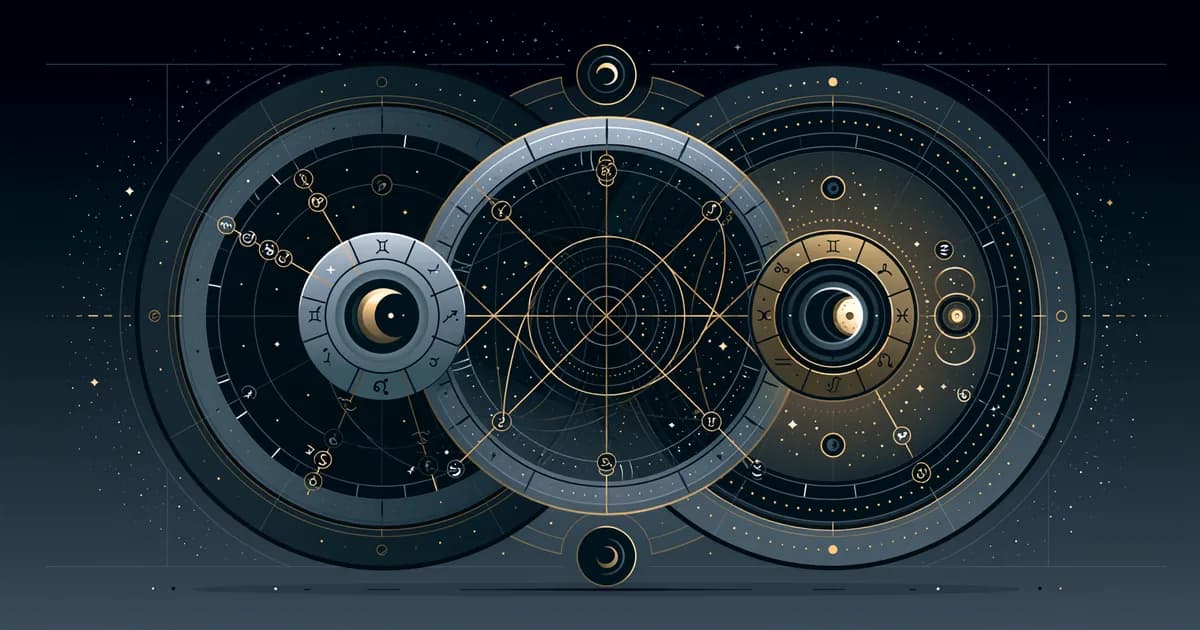
Synastry overlays two birth charts to show how two people meet — attraction, communication, emotional rhythm, and friction. Here's what a synastry chart is and how it's read.
What Synastry Actually Is
Synastry is the branch of astrology that compares two birth charts to understand the relationship between two people. If you have ever wondered what is synastry in plain terms, here it is: you take one person's complete natal chart — the full map of the sky at their birth — and you take the other person's complete natal chart, and you study how the two interact. Nothing is averaged, nothing is blended, nothing is reduced to a single number. Both charts stay whole, and the work is in reading the conversation between them.
The cleanest way to picture it is two maps laid on top of each other. Imagine each person's chart printed on a clear sheet — a full circle of signs, planets, and houses. Synastry sets one sheet directly over the other and asks what lines up, what clashes, and what quietly supports. Where your planet falls against their planet, where their Sun lands among your houses, where two charts strike sparks and where they find ease — that overlap is the entire subject. This two wheels overlapping image is the heart of synastry chart meaning: the picture lives in the relationship between the layers, not in either layer alone.
This is worth stressing, because it is the most common point of confusion. A synastry chart is not one merged chart that represents "the couple" as a third entity. It keeps both people distinct, fully themselves, and looks at how those two distinct people meet. (There is a separate technique that builds a single combined chart — the composite — and we will come back to how it differs later.) Synastry is relational by nature: it is always about the space between two individuals, each of whom remains the author of their own chart.
That relational focus is exactly why synastry is the go-to tool for relationship compatibility astrology. Romantic partners are the obvious case, but the same method works for any close bond — friends, business partners, parent and child. Anywhere two people's lives genuinely intertwine, overlaying their charts can illuminate how they naturally fit, where they rub, and what each draws out of the other. That, in a sentence, is synastry explained: two whole charts, one laid over the other, read as a relationship rather than a person.
What You Need to Cast One
Because synastry compares two charts, you need the raw ingredients for both of them — and the requirements are exactly the same as for any single birth chart, just doubled. For each person you need three things: the exact date of birth, the exact time of birth, and the place of birth (the city is usually enough). With those six pieces of information — three per person — an astrologer can cast two accurate natal charts and begin laying one over the other.
The most easily overlooked of these is the birth time, and it matters far more than people expect. The time of birth is what fixes the Ascendant, the Midheaven, and the whole framework of the twelve houses — the angles and rooms that turn a list of planetary positions into a personal chart. Without an accurate time, the houses can be wrong by a sign or more, and in synastry the houses do heavy lifting: half of the reading is about whose planets land in whose houses, which is meaningless if the houses themselves are unreliable. A guessed or rounded time can quietly distort the comparison. This is the same reason why your exact birth time matters for a solo natal reading — only here the stakes are doubled, since an error in either chart degrades the overlay.
There is a privacy dimension here that is easy to skate past but genuinely important. Synastry needs another living person's most personal data — when and where they were born — and that information is theirs. The healthy, honest way to do synastry is together, or at least with the other person's knowledge and agreement: you'll need both people's birth details, with their knowledge, ideally because they are curious about the relationship too. Synastry is at its best as a shared, consensual exploration between two people who both want to understand the connection.
It is worth saying the opposite plainly, so there is no ambiguity: synastry is not a tool for quietly charting someone behind their back or analyzing an ex without their knowledge. Beyond the obvious matter of respect, a reading built on data someone did not share willingly tends to be a poor reading anyway — it invites projection rather than understanding. Approached mutually, with both people's blessing, synastry becomes what it is meant to be: a conversation two people have about the space between them.

The Building Blocks: Inter-Aspects, House Overlays, Chemistry
Once both charts are cast and overlaid, a synastry reading is built from three layers that stack together. Learning to recognize these three is most of what it takes to understand how to read a synastry chart, because almost everything an astrologer points to falls into one of them. They are the inter-aspects, the house overlays, and the broader elemental and modality balance between the two charts.
The first layer is inter-aspects — the angular relationships between one person's planets and the other person's planets. When your Venus sits at a meaningful angle to their Mars, or their Moon aligns with your Mercury, that connection is an inter-aspect, and it describes a specific way the two of you interact. Some of these contacts feel harmonious and easy; others are charged, energizing, or friction-filled; and crucially, friction is not the same as "bad" — challenging contacts are often where attraction and growth live. Inter-aspects are the engine of the reading, the planet-to-planet wiring that carries most of the felt chemistry. There is a lot of nuance in which planets are involved and how they connect, which is why synastry aspects explained is worth a closer look on its own.
The second layer is house overlays — the question of whose planets land in whose houses. Remember that each person's chart has its own set of twelve houses, each governing an area of life (identity, home, communication, partnership, career, and so on). When you overlay the charts, your partner's planets fall into specific houses of your chart, and yours fall into specific houses of theirs. That tells you which areas of life each person activates in the other: someone whose planets land in your relationship house touches your bonding and partnership themes, while someone landing in your career house energizes your ambitions and public life. The same planet lands differently depending on the house it visits, which is why house overlays in synastry add a whole second dimension on top of the aspects.
The third layer is the wider elemental and modality balance — the chemistry of temperaments. Beyond individual contacts, astrologers look at how the two charts compare in their distribution across the four elements (fire, earth, air, water) and the three modalities (cardinal, fixed, mutable). One chart heavy in fire and air meeting another heavy in earth and water can describe two people with genuinely different default rhythms — one quick and outward, the other steady and inward. That contrast is neither good nor bad in itself; it simply shapes the texture of the relationship and where the natural give-and-take will be. Read together, these three layers — inter-aspects, house overlays, and elemental balance — turn two separate charts into a coherent portrait of how two people actually mesh.
What Synastry Can Tell You (and What It Can't)
A synastry chart is genuinely revealing about the shape of a connection. It shows you the relationship's natural strengths — where the two of you understand each other almost without trying, where affection flows easily, where your instincts line up. It shows you the points of friction — the topics where you tend to misread each other, the places where two different rhythms grind, the recurring tension that flares around certain themes. And it shows you the growth edges: the areas where the relationship asks each person to stretch, to develop patience, or to learn something the other models naturally. Read this way, synastry is a remarkably good map of the terrain a relationship covers.
What it is not is a verdict. A synastry chart does not score a couple, rank them against other couples, or return a yes-or-no answer on whether two people "should" be together. That kind of pass/fail framing badly misunderstands what the chart is doing. Two charts with plenty of easy contacts can still drift apart through neglect, and two charts full of friction can build something durable and alive because the friction keeps them engaged and growing. The chart describes the raw material; what gets built from it is the work of two people, not a foregone conclusion written in the planets.
This is also where it matters to set aside any notion that synastry reveals a fixed fate. There is no guaranteed soulmate hidden in the geometry, and no contact dooms a relationship either. The deeper, more challenging themes a synastry chart surfaces are best understood as lessons and invitations to grow, not as a script that must play out. A demanding contact is a place the relationship can mature; an easy one is a gift that still has to be tended. Agency stays with the people, always.
So the honest framing is this: synastry is a tool for understanding, not prediction or judgment. It answers "how do these two people tend to meet, where do they flow, and where will they have to work?" far better than "are they compatible, yes or no?" Used in that spirit — as insight into a living relationship rather than a sentence handed down about it — synastry helps two people see each other more clearly and meet each other more kindly, which is worth far more than any verdict could be.
Synastry vs. the Other "Couple" Charts
Synastry is the best-known way to look at a relationship astrologically, but it is not the only one, and it is easy to mix it up with its closest relative. The main alternative is the composite chart, and understanding the difference clears up a lot of confusion about what each technique can actually tell you.
The distinction comes back to that two maps laid on top of each other image. Synastry keeps both charts whole and separate, reading the interaction between two distinct people — it is fundamentally about "you and me" and the space between us. The composite chart does something different: it mathematically combines the two charts into a single new chart that represents "the relationship itself" as one entity. Where synastry has two Suns, two Moons, and two of everything, a composite has just one of each, derived from both. It is less about how two people meet and more about the character of the bond they form together — the relationship treated as a thing in its own right.
Neither approach is more "correct"; they answer different questions and are often read side by side. Synastry tells you about the chemistry, the attractions, and the friction between the partners — the lived, day-to-day experience of relating. The composite speaks to the relationship's overall purpose and feel as a unit, the third thing two people create when they come together. Many astrologers begin with synastry to understand the interaction, then turn to the composite to understand the bond as an entity, treating the two as complementary lenses rather than competitors.
If you want the full comparison — how each chart is built, what each is good at, and how to use them together without conflating them — synastry vs. composite walks through it in detail. For now, the headline is simple: synastry is the relationship between two charts, while the composite is a single chart of the relationship. Keep that one line straight and the rest of the distinction tends to fall into place.
The Connections That Carry the Most Weight
A synastry comparison can surface dozens of contacts, which is overwhelming at first. In practice, a handful of connections carry most of the weight in describing a relationship, and learning to spot these first makes the whole overlay far more readable. The ones to know cluster around four themes: the lights, attraction, communication, and the deeper bonds. (If the building-block terms here feel new, it is worth grounding yourself first in what is a natal chart and your Big Three, since synastry sits directly on top of those fundamentals.)
The first and most important are the lights — the Sun and the Moon. Sun-to-Sun and Sun-to-Moon contacts between two charts speak to a basic sense of recognition: do these two people "get" each other at the level of core identity and emotional nature? The Sun is the conscious self and the Moon is the inner emotional world, so strong, supportive contacts between them often describe a relationship where each person feels genuinely seen. These are foundational; they tend to set the baseline warmth or distance of the entire connection.
Next come the planets of attraction and communication. Venus and Mars are the classic chemistry pair — Venus governs affection, taste, and what we find lovely, while Mars governs desire, drive, and how we pursue; contacts between them across two charts are where romantic and physical magnetism usually shows up, which is why Venus & Mars in synastry gets so much attention. Mercury, meanwhile, runs communication — how two people think, talk, and process — and supportive Mercury contacts are quietly essential for the day-to-day ease of relating. Mercury often pairs with the Moon in describing whether two people can both talk and feel their way through life together, which is why Moon & Mercury in synastry is worth understanding as a unit.
Finally there are the connections that describe the relationship's deeper, longer arc: Saturn and the lunar nodes. Saturn contacts bring weight, commitment, and a sense of structure — they can feel sobering, but they are often what gives a bond endurance and seriousness. The nodes touch on themes of meaningful growth and the lessons two people draw out of each other over time. These are best held in the anti-fatalistic spirit of this whole piece: they point to where a relationship can deepen and mature, not to a fixed destiny — Saturn, the nodes & karmic connections explores how to read them as growth rather than fate. Take all of these together — lights, attraction, communication, and the deeper bonds — and you have the spine of a synastry reading.
Reading even those key contacts well, across two full charts and alongside the house overlays and elemental balance, is a real undertaking — and the most meaningful insights come from how everything interacts, not from any single placement. If you would like that work done thoroughly and for the two of you specifically, a TriMoon Synastry (Relationship Compatibility) report turns both charts into a complete, personalized reading of how the two of you actually connect — the chemistry, the communication, the friction, and the growth edges, all in one place.
This article was written by AI and has not been reviewed by a person. The astronomy behind it is TriMoon's own precise ephemeris data — not generic horoscopes.